Chee Kung Tong · San Francisco · Historical portraits

Five Revolutionary
Pioneers

緬懷五位革命先驅

Five lives. A generation of change.
Remembering 史堅如, 吳樾, 徐錫麟, 鄒容 and 陳天華 through the portraits preserved in our community and the historical record.

Select a portrait to read the biography.

Memory & historical context · 歷史與追思

The generation before 1911

These five men died before the 1911 Revolution. Their different paths—organizing, teaching, publishing and armed action—belong to the wider history of opposition to Qing rule. This page brings their stories together for remembrance; it does not suggest they formed a single organization or a formally named group of five.

The five portraits were supplied by the San Francisco chapter. Their original makers and production dates have not been established. The memorial inscriptions are preserved as part of each image. The biographies below draw on museum and archival sources; they do not assert that these figures were members of, or visitors to, the San Francisco lodge.

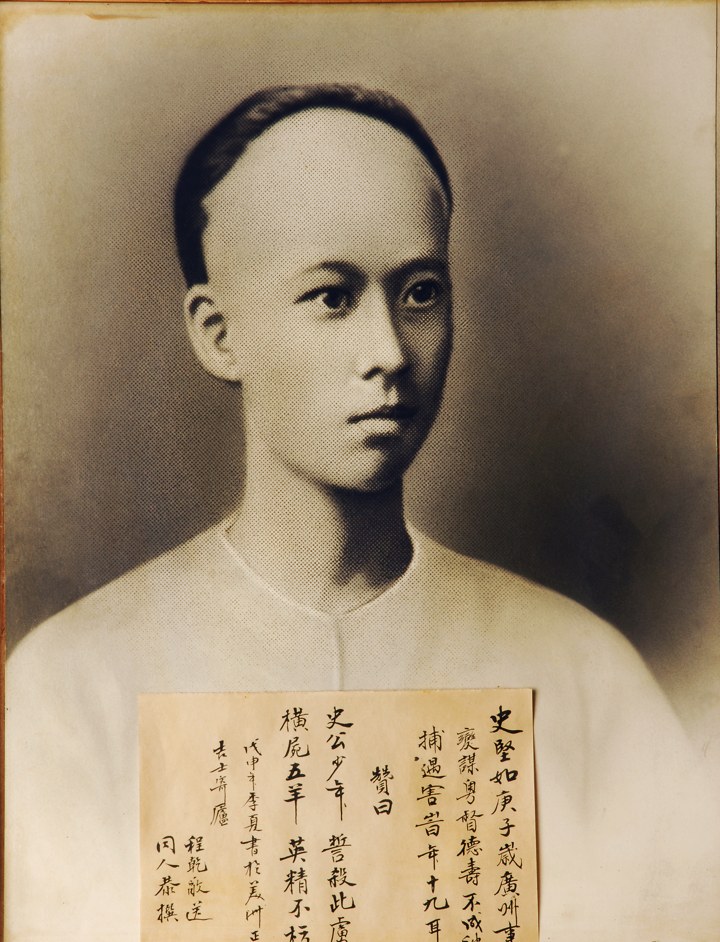
Full commemorative portrait of Shi Jianru (史堅如), including its original inscription
Portrait supplied by the San Francisco chapter.
Original maker and date not established. Full supplied image retained.

Portrait 01 · Guangdong

史堅如Shi Jianru

1879–1900

Organizing in the early revolutionary movement

Shi Jianru belonged to the early generation of revolutionaries associated with Sun Yat-sen. In 1899, contacts in Macau and Hong Kong brought him into the revolutionary network. He joined the Revive China Society (興中會), met Sun in Japan, and returned to southern China to help organize resistance to Qing rule.

During the 1900 Huizhou uprising, Shi sought to support the movement through action in Guangzhou. An attempt against the official Deshou failed; the explosion also damaged nearby homes. Shi was arrested and executed in Guangzhou on November 9, 1900.

Later commemorations placed Shi among the pioneers who died before the revolution succeeded. His story records the risks of clandestine organizing and the human consequences of the movement’s turn to violence.

史堅如於1899年加入興中會,並赴日本與孫中山會面。1900年,他在廣州策應惠州起義,行動失敗後被捕,於同年11月9日遇害。後世將他列為辛亥革命前期的重要先驅。
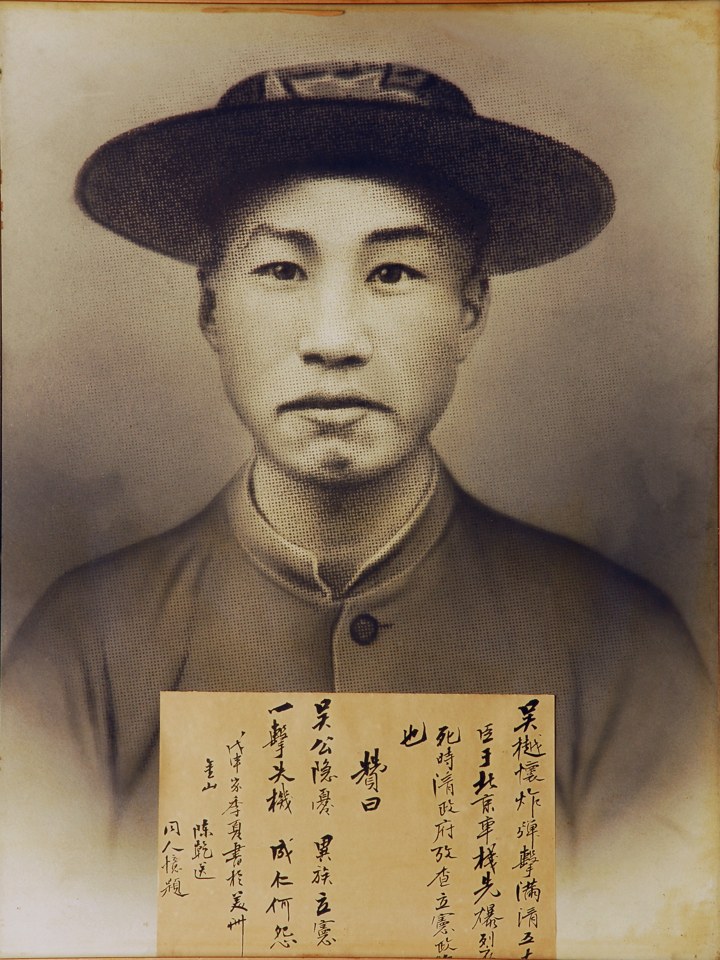
Full commemorative portrait of Wu Yue (吳樾), including its original inscription
Portrait supplied by the San Francisco chapter.
Original maker and date not established. Full supplied image retained.

Portrait 02 · Tongcheng, Anhui

吳樾Wu Yue

1878–1905

At the crossroads of reform and revolution

Wu Yue, also known as Mengxia, came from Tongcheng in Anhui. His activities included teaching and vernacular journalism in Baoding. Like other young radicals of his generation, he questioned whether constitutional reform could transform the Qing political order.

In 1905, the Qing government prepared to send five officials abroad to investigate constitutional systems. On September 24, Wu attacked the delegation at Beijing’s Zhengyangmen railway station. He died in the explosion, which also killed attendants and injured officials. The delegation’s mission was interrupted and later reorganized.

The National Palace Museum’s surviving diplomatic letters preserve an unusual documentary trace of this episode. Wu’s life belongs within the difficult history of reform, revolution and political violence—not a simple account of an attack ending constitutional reform.

吳樾是安徽桐城人,曾從事教育與白話報刊工作。1905年,他反對清廷派遣五大臣出洋考察憲政,在北京車站發動襲擊並身亡。事件造成傷亡,也反映晚清改革與革命路線的激烈衝突。

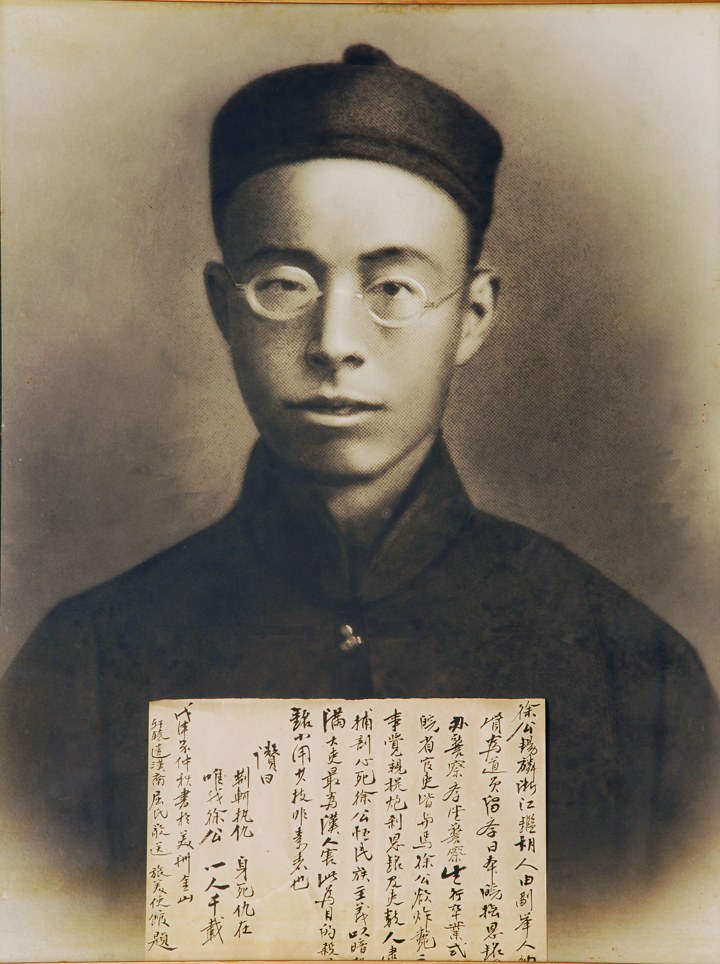
Full commemorative portrait of Xu Xilin (徐錫麟), including its original inscription
Portrait supplied by the San Francisco chapter.
Original maker and date not established. Full supplied image retained.

Portrait 03 · Shaoxing, Zhejiang

徐錫麟Xu Xilin

1873–1907

Education, organization and the Anqing uprising

Xu Xilin was a native of Dongpu, Shaoxing. After traveling to Japan in 1903, he helped circulate new ideas through books and newspapers. He joined the Restoration Society (光復會) in 1904 and helped establish Datong School (大通學堂) in 1905, making education an important part of revolutionary organization.

Xu subsequently took a position connected with police education in Anhui. On July 6, 1907, he killed the provincial governor Enming and led an uprising in Anqing. The uprising failed; Xu was captured and executed that July.

Museum collections preserve both a manuscript associated with Xu’s planning and later commemorative portraits linking him with Qiu Jin. These different objects illuminate two histories: the practical organization of revolution and the ways later generations remembered its dead.

徐錫麟是浙江紹興人,於1904年加入光復會,並參與創辦大通學堂,以教育推動革命組織。1907年7月6日,他在安慶發動起義,失敗後被捕遇害。其手稿與紀念肖像,見證了革命活動及後世追思。

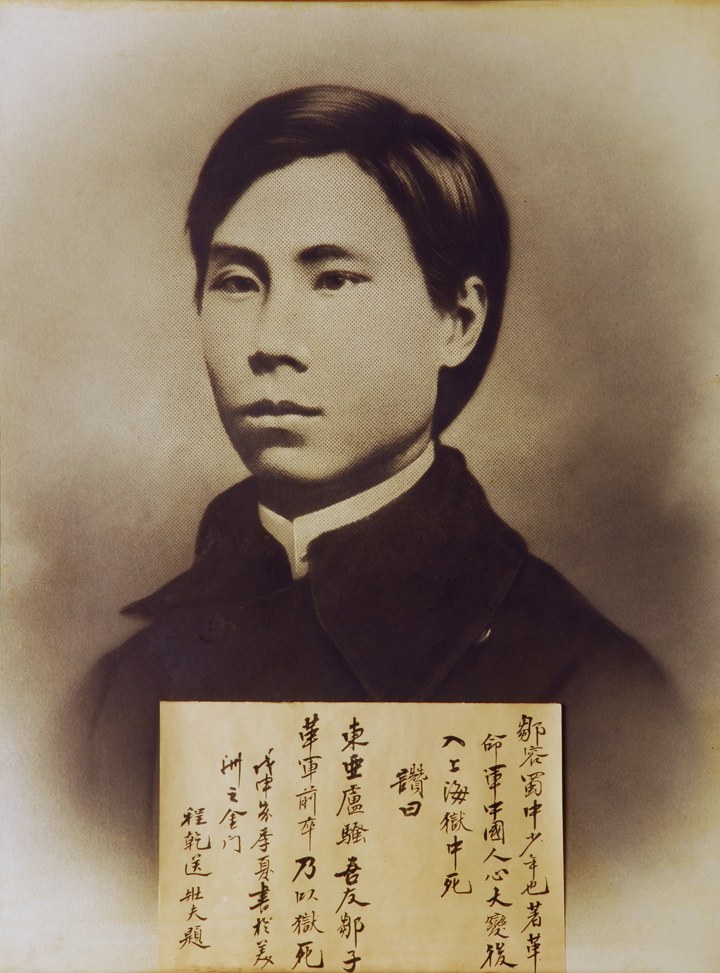
Full commemorative portrait of Zou Rong (鄒容), including its original inscription
Portrait supplied by the San Francisco chapter.
Original maker and date not established. Full supplied image retained.

Portrait 04 · Ba County, Sichuan · present-day Chongqing

鄒容Zou Rong

1885–1905

A young writer and the power of print

Zou Rong came from Ba County, in what is now Chongqing, and studied in Japan before returning to China. His short book The Revolutionary Army (《革命軍》), published in Shanghai in 1903, urged the overthrow of the Qing dynasty and the creation of a republic. It became one of the best-known revolutionary publications of its time.

The book appealed to liberty and equality, while also using the anti-Manchu ethnic rhetoric of its historical setting. Reading it today requires attention to both its political influence and the exclusions embedded in that language.

Zou was imprisoned during the 1903 Subao press affair, which also involved Zhang Taiyan. He died in a Shanghai prison in April 1905. His brief life shows how pamphlets, newspapers and young overseas students helped carry revolutionary ideas beyond small circles of organizers.

鄒容生於四川巴縣,即今重慶一帶。1903年出版《革命軍》,主張推翻清廷、建立共和政體,影響廣泛。同年因《蘇報》案入獄,1905年4月病逝於上海獄中。他的著作亦須放在當時民族論述的背景下理解。

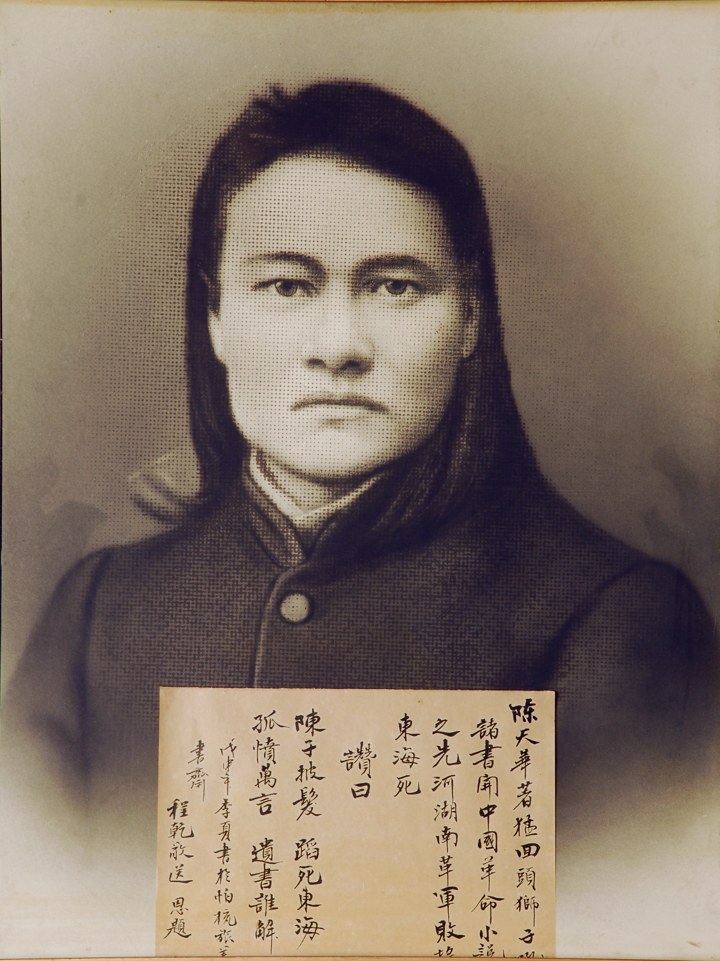
Full commemorative portrait of Chen Tianhua (陳天華), including its original inscription
Portrait supplied by the San Francisco chapter.
Original maker and date not established. Full supplied image retained.

Portrait 05 · Xinhua, Hunan

陳天華Chen Tianhua

1875–1905

Making political ideas accessible

Chen Tianhua, from Xinhua in Hunan, used accessible language to bring political arguments to a broad readership. While studying in Japan in 1903, he wrote The Alarm Bell (《警世鐘》) and A Sudden Look Back (《猛回頭》). These works warned of foreign imperial pressure, criticized the Qing government and encouraged political awakening.

He took part in the China Revival Society (華興會) and later joined the Chinese Revolutionary Alliance (同盟會). His work for revolutionary publications, including Minbao (《民報》), connected organizing with the written word.

Chen died by suicide in Tokyo in December 1905 amid a dispute over restrictions affecting Chinese students in Japan. His death should be understood without romanticizing it. His enduring contribution lies in writing that made the urgent political questions of his age available to ordinary readers.

陳天華是湖南新化人,1903年赴日本留學,撰寫《警世鐘》與《猛回頭》,以通俗文字傳播救國與革命思想。他參與華興會、同盟會及《民報》工作,於1905年12月在東京去世。其文字對晚清政治啟蒙影響深遠。

A shared chronology · 時代脈絡

Before the republic

  1. 1900Shi Jianru’s Guangzhou action and execution.
  2. 1903Zou Rong and Chen Tianhua publish influential revolutionary works.
  3. 1905Zou Rong dies in prison; Wu Yue dies in Beijing; Chen Tianhua dies in Tokyo.
  4. 1907Xu Xilin leads the failed Anqing uprising. Four years later, the 1911 Revolution begins.